
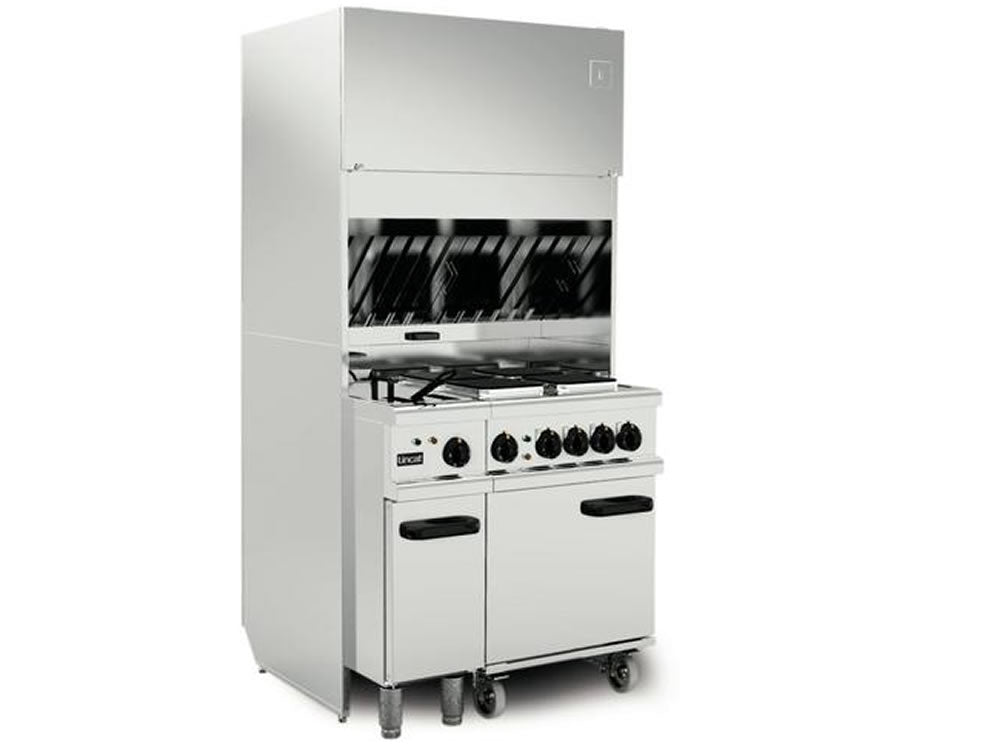
Lincat Y10020 Recirculation Unit – Ductless Extraction Canopy
Product Description
The Lincat Y10020 is a free-standing, self-contained recirculation canopy designed for commercial kitchens where connecting to external ductwork is not a practical option. Rather than expelling air to atmosphere, it...
Specifications
- External depth (mm)
- 734
- External height (mm)
- 222
- External width (mm)
- 1050
- Power rating (kw)
- 1.5
Product Description
The Lincat Y10020 is a free-standing, self-contained recirculation canopy designed for commercial kitchens where connecting to external ductwork is not a practical option. Rather than expelling air to atmosphere, it draws cooking vapours through a four-stage filtration process — a stainless steel baffle filter captures grease particles first, followed by a G4 matrix panel filter, a HEPA filter, and finally a loose granule carbon filter to address odours — before returning treated air to the kitchen. The result is a measurable improvement in air quality at the cooking station, without duct runs, roof penetrations, or the make-up air systems that conventional extraction requires.
In operational terms, the unit is well suited to situations where installation cost or building constraints rule out traditional extraction: listed buildings, basement kitchens, food service within hotels or offices, and dark kitchen environments where layout flexibility matters. Because it requires no fixed ductwork, the unit can be repositioned if the kitchen changes — a genuine advantage in smaller or evolving operations.
- No external ducting required, significantly reducing installation cost and building works
- Self-contained design allows repositioning as kitchen layouts change
- Four-stage filtration addresses both grease and odour within a single unit
- Stainless steel baffle filters are dishwasher-safe and straightforward to clean weekly
- Panel, HEPA, and carbon filters are visually inspectable and replaceable as required
There are important considerations before specifying this unit. It is designed exclusively for use above electric appliances — it is not suitable for positioning above gas cooking equipment. The unit does not reduce extracted air temperature, so supplementary cooling may be worth considering during warmer months. A background ventilation rate of roughly ten to fifteen air changes per hour is advisable, and most commercial kitchens will already meet this through existing passive or mechanical ventilation. Assembly requires two people and typically takes around an hour including unpacking.
Filter maintenance needs to be built into a regular kitchen schedule. The baffle filters require washing weekly; the panel, HEPA, and carbon filters are consumables that need periodic replacement depending on cooking intensity. For higher-volume sites, operations with heavier cooking loads, or any kitchen using gas appliances, a fully ducted extraction solution is likely to be more appropriate.
If you are weighing up whether a recirculation unit suits your site — or have questions about background ventilation requirements or filter maintenance cycles — we are happy to talk it through before you commit.
Key Features
- Four-stage filtration system captures grease particles and eliminates cooking odours
- Stainless steel baffle filters are removable and dishwasher-safe for easy maintenance
- Free-standing, self-contained design requires no fixed ductwork or roof penetrations
- HEPA and loose granule carbon filters provide secondary and tertiary air treatment
- Repositionable unit accommodates changing kitchen layouts without major installation work
Operational Benefits
- Reduces installation cost significantly by eliminating external ductwork requirements
- Improves air quality at the cooking station without structural building alterations
- Suits constrained or listed buildings where conventional extraction is not permitted
- Weekly baffle cleaning keeps maintenance straightforward and within kitchen routine
- Flexible positioning supports evolving kitchen layouts without committing to fixed infrastructure
Specifications
- External depth (mm)
- 734
- External height (mm)
- 222
- External width (mm)
- 1050
- Power rating (kw)
- 1.5
- Power type
- Electric 1 Phase
- Weight (kg)
- 175
Frequently Asked Questions
- No — this unit is designed exclusively for use above electric appliances. If your kitchen operates gas ranges, griddles, or fryers, a fully ducted extraction canopy rated for gas is the appropriate solution. Using a recirculation unit above gas equipment is not recommended and may not satisfy ventilation regulations.
- A background ventilation rate of approximately ten to fifteen air changes per hour is advisable to support the recirculation process. Most commercial kitchens already achieve this through existing passive or mechanical ventilation, but it is worth confirming before installation, particularly in basement or enclosed spaces.
- The stainless steel baffle filters require washing weekly, which can be managed as part of a standard kitchen cleaning routine. The panel, HEPA, and carbon filters are consumables that need replacing periodically — how frequently depends on cooking intensity. A quick visual inspection during the weekly baffle clean is generally sufficient to judge when replacements are due, though higher-volume operations should expect to replace consumable filters more regularly.