
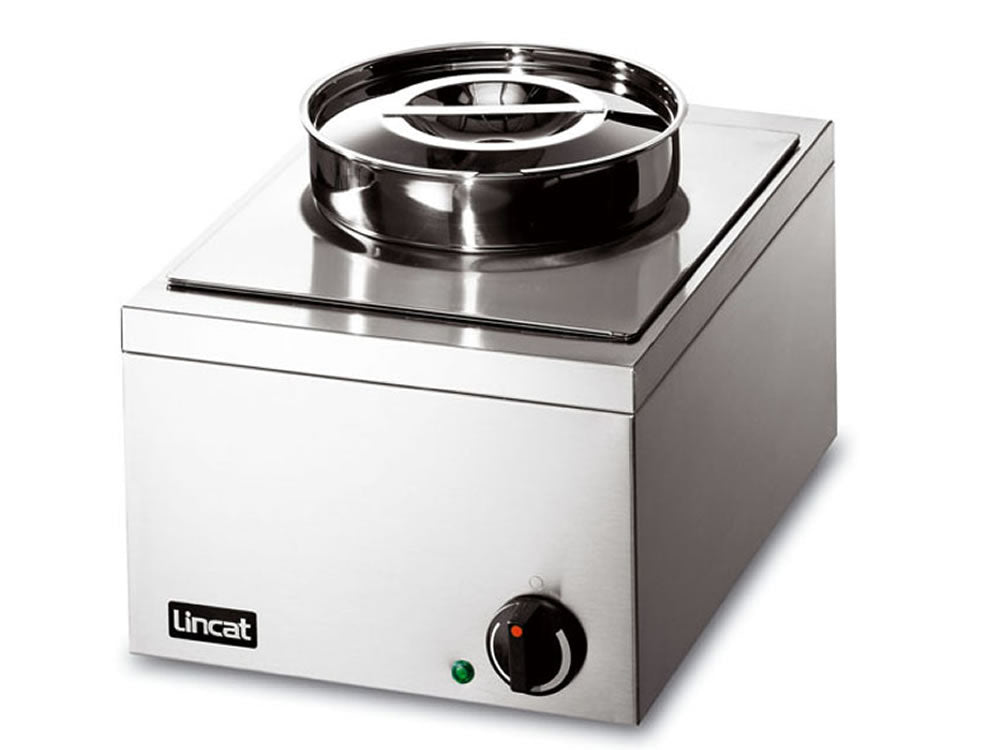
Lincat LRBW Wet Heat Bain Marie with Round Stainless Steel Pot
Product Description
The Lincat LRBW is a single-pot wet heat bain marie designed to hold pre-cooked food at safe serving temperatures throughout a service period. It uses water heated beneath a round...
Specifications
- External depth (mm)
- 400
- External height (mm)
- 245
- External width (mm)
- 285
- Power rating (kw)
- 0.25
Product Description
The Lincat LRBW is a single-pot wet heat bain marie designed to hold pre-cooked food at safe serving temperatures throughout a service period. It uses water heated beneath a round stainless steel pot to transfer heat gently and evenly from the outside in — a method that keeps food in consistently good condition without the surface drying or crusting that can occur with dry heat alternatives.
Wet heat holding is generally the preferred approach where food quality needs to be maintained across an extended service. Sauces, gravies, soups, and vegetables all respond well to a moist heat environment — texture stays consistent, appearance remains presentable, and food is ready to plate directly from the unit without rework. The adjustable temperature control allows operators to dial in an appropriate holding temperature for the food type in use and to keep within food safety requirements throughout the shift.
From a practical standpoint, this format offers several day-to-day advantages:
- Moist heat environment protects texture and appearance of sauces, soups, and vegetables
- Adjustable temperature control supports safe holding across a full service
- Stainless steel pot and construction cleans down quickly between services
- Compact footprint suits counter and servery positions with limited space
- Electric connection keeps installation simple with no gas or water supply required
As an electric unit, the installation requirements are straightforward — a suitable mains supply and a stable, level surface are the main considerations. It is worth noting that wet heat units do use slightly more energy than dry heat alternatives, since water must be heated and maintained throughout service. For operations running the unit across long back-to-back shifts, that running cost is a reasonable factor to weigh when choosing between formats.
This unit is well suited to smaller operations — cafés, pub kitchens, small restaurants, or catering functions — where a single pot of sauce, soup, or a side dish needs to be held reliably through service. Where an operation requires holding several food types simultaneously or is running a high-throughput service, a multi-well or larger-capacity unit is likely to be a better fit.
If you are weighing up wet heat versus dry heat holding for your menu, or want to talk through whether a single-pot unit covers your service requirements, the team is happy to help you work it out before you commit.
Key Features
- Wet heat water bath transfers heat evenly to the round stainless steel pot
- Adjustable temperature control for precise food-safe holding throughout service
- Supplied with one round stainless steel pot for immediate use
- Electric operation requires only a standard mains supply connection
- Compact single-well format designed for counter and servery installations
Operational Benefits
- Keeps sauces, soups and gravies at consistent quality across a full service
- Reduces surface drying and crusting compared with dry heat holding methods
- Supports food safety compliance with reliable adjustable temperature control
- Simple installation means minimal setup time and no specialist fitting required
- Compact footprint works within tight counter and servery layouts
Specifications
- External depth (mm)
- 400
- External height (mm)
- 245
- External width (mm)
- 285
- Power rating (kw)
- 0.25
- Power type
- Electric 1 Phase
- Weight (kg)
- 7
Frequently Asked Questions
- For liquid and semi-liquid foods — sauces, gravies, soups, and vegetable dishes — wet heat is generally the preferred method. The moist environment prevents surface drying and keeps texture consistent through an extended service, which dry heat alternatives can struggle to replicate. If you are holding drier foods or items where moisture retention is less critical, dry heat may be a simpler option worth considering.
- As an electric unit, the main requirement is a suitable mains power supply and a stable, level surface. There is no gas connection or plumbed water supply needed, which makes it straightforward to position on a counter or servery without specialist installation. It is worth ensuring the surface can take the combined weight of the unit, water, and food during service.
- For smaller operations holding one food type at a time — a soup, a sauce, or a side — a single-pot unit is often perfectly adequate. If your service requires holding multiple food types simultaneously, or if you are running a high-volume operation where a larger capacity would reduce the need to replenish frequently, a multi-well unit is likely to be a more practical choice. If you are unsure which format fits your service pattern, it is worth talking it through before ordering.