
Tournus 808 182 Twin Ambient Plate Dispenser
Product Description
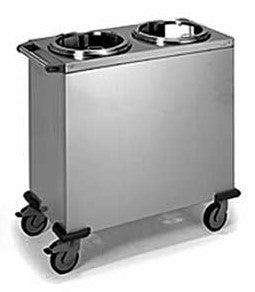
The Tournus 808 182 is a mobile, twin-stack ambient plate dispenser designed for buffet counters, cafeteria serveries, and self-service operations where plates need to be kept readily accessible at the...
Specifications
- External depth (mm)
- 960
- External height (mm)
- 900
- External width (mm)
- 485
- Material
- Stainless Steel
Downloads
Product Description
The Tournus 808 182 is a mobile, twin-stack ambient plate dispenser designed for buffet counters, cafeteria serveries, and self-service operations where plates need to be kept readily accessible at the point of service. It holds two separate stacks side by side, and as an ambient unit it is intended for room-temperature plate presentation rather than heated or chilled service.
In practice, this type of dispenser proves its worth in sites that turn over a steady volume of covers — staff canteens, school dining halls, hotel buffets, and healthcare refectories. The twin-stack layout means one column can be replenished while service continues from the other, reducing the chance of a gap in plate supply during a busy sitting. Plates are presented neatly at the point of collection, which supports a smoother flow through the servery line.
The unit runs on a wheeled trolley base with braked castors, allowing it to be repositioned between services or moved clear for thorough cleaning. The adjustable column diameter means the same dispenser can accommodate more than one plate size, which is useful for sites running different plates across breakfast, lunch, and dinner service. Steel construction with polyethylene bumpers helps protect both the unit and surrounding furniture during movement in tight servery spaces.
- Twin-stack layout allows replenishment of one column without interrupting service
- Mobile base with braked castors for repositioning and cleaning access
- Adjustable column accommodates a range of plate diameters
- Steel construction with bumper protection for busy servery environments
- Keeps plates at the point of service without cluttering the counter
This dispenser is well suited to medium-volume self-service operations. Sites with very high throughput, or where heated plate presentation is required, should consider a powered or larger-capacity alternative from the range.
If you want to talk through whether this model fits your servery layout or the plate sizes you run, our team is glad to help before you commit to an order.
Key Features
- Twin-stack configuration holds two separate columns of plates simultaneously
- Wheeled trolley base with braked castors for controlled repositioning
- Adjustable column diameter accommodates multiple plate sizes from one unit
- Steel frame construction with polyethylene bumpers for contact protection
- Ambient operation suitable for room-temperature plate presentation at the servery
Operational Benefits
- Continuous plate supply maintained as one stack is replenished during service
- Mobile base allows quick repositioning between services or for deep cleaning
- One dispenser serves multiple plate sizes, reducing equipment duplication
- Braked castors keep the unit stable and safe during busy service periods
- Neat plate presentation at point of collection supports faster servery flow
Specifications
- External depth (mm)
- 960
- External height (mm)
- 900
- External width (mm)
- 485
- Material
- Stainless Steel
Downloads
Frequently Asked Questions
- The twin-stack layout gives a useful buffer of plates at the servery, making it well suited to medium-volume sites such as staff canteens, school halls, and hotel buffets. For very high-throughput operations turning over a large number of covers in a short sitting, a heavier-duty or higher-capacity model may provide a more reliable supply without requiring constant replenishment.
- No — this is an ambient unit only, designed to hold plates at room temperature. If your operation requires pre-heated plates at the point of service, you would need to look at a powered heated plate dispenser instead. It is worth considering whether your menu and service style genuinely require heated plates, as many self-service operations run successfully with ambient dispensing.
- The column is adjustable to suit a range of plate diameters, which means the same unit can be used across different plate sizes if your operation changes between services. We would recommend confirming your specific plate diameter against the adjustment range before ordering, and our team can help you verify compatibility if needed.