
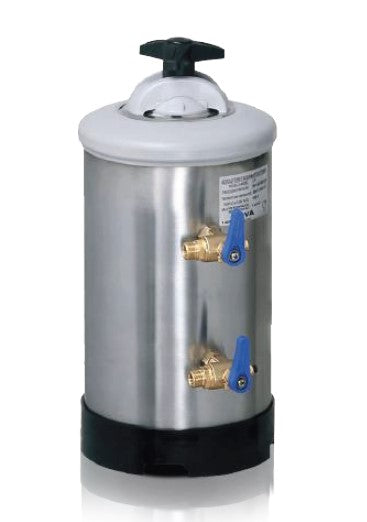
EWC 12 Litre Manual Water Softener for Dishwashers
Product Description
The EWC 12 Litre Manual Water Softener is a compact inline unit designed to reduce water hardness in the supply line feeding a commercial dishwasher or glasswasher. It works by...
Specifications
- External depth (mm)
- 190
- External height (mm)
- 500
Downloads
Product Description
The EWC 12 Litre Manual Water Softener is a compact inline unit designed to reduce water hardness in the supply line feeding a commercial dishwasher or glasswasher. It works by passing incoming water through a resin bed that exchanges calcium and magnesium ions — the minerals responsible for limescale — for sodium ions, delivering softened water to the machine without requiring any electrical connection.
Hard water is one of the most consistent causes of premature failure in commercial warewashing equipment. Limescale accumulates progressively on heating elements, spray arms, and wash chamber surfaces, reducing cleaning effectiveness, increasing energy consumption, and shortening equipment life. Fitting a softener upstream of the machine addresses the problem at source rather than managing the consequences later.
For day-to-day operation, this unit offers a straightforward set of practical advantages:
- No electrical connection required — purely plumbed inline installation
- Regenerates manually using standard salt — no automated controls to maintain or calibrate
- Stainless steel construction suited to commercial kitchen environments
- Flexible hose fitting included to ease connection to existing pipework
- Compact footprint suits installations where under-sink space is limited
Installation requires the unit to be plumbed into the cold water supply line ahead of the machine. Regeneration is a manual process — the operator flushes the resin bed with salt solution at intervals determined by local water hardness and daily throughput. It is worth noting that this softener is not appropriate for equipment producing a consumable output, such as ice machines, coffee equipment, or combi ovens with steam injection. Those applications require a separately filtered or treated supply.
This unit is well suited to small cafés, bars, pubs, and hospitality operations running a single glasswasher or compact dishwasher in a hard water area. Sites with higher-throughput machines, harder water, or multiple units to protect should consider a larger-capacity softener to match the demand.
If you are unsure whether this unit is the right match for your machine or your local water conditions, the team is happy to help you work it out before you commit.
Key Features
- Ion-exchange resin bed removes calcium and magnesium from incoming water
- Manual regeneration using standard salt — no electrical connection required
- Stainless steel body withstands demanding commercial kitchen environments
- Flexible hose fitting supplied for straightforward connection to existing pipework
- Compact 12-litre capacity suits single glasswasher or compact dishwasher installations
Operational Benefits
- Protects heating elements from limescale build-up, extending equipment service life
- Reduces energy consumption caused by scale-insulated heating elements over time
- Helps maintain consistent wash results throughout the service period
- Low-maintenance operation with no controls or calibration to manage
- Simple inline installation keeps disruption and installation costs to a minimum
Specifications
- External depth (mm)
- 190
- External height (mm)
- 500
Downloads
Frequently Asked Questions
- Regeneration frequency depends on your local water hardness and the volume of covers you're putting through each day. In very hard water areas with high throughput, you may need to regenerate weekly; in moderately hard areas with lighter use, less often. A water hardness test strip is a useful tool for monitoring output quality and helps you establish the right interval for your site.
- No — this unit is designed specifically for dishwashers and glasswashers. Equipment that produces a consumable output, such as combi ovens with steam injection, coffee machines, or ice makers, requires a dedicated filtration system rather than a standard ion-exchange softener. Using this unit on those applications would not be appropriate.
- For a single compact dishwasher or undercounter glasswasher running a moderate service, a 12-litre unit is generally adequate. Sites running a higher-throughput pass-through or rack machine, or operating in a very hard water area, would typically benefit from a larger-capacity softener to keep pace with demand without overly frequent regeneration cycles.