
Vestfrost VT547-60 495 Ltr Ultra-Low Temperature Chest Freezer -60°C
Product Description
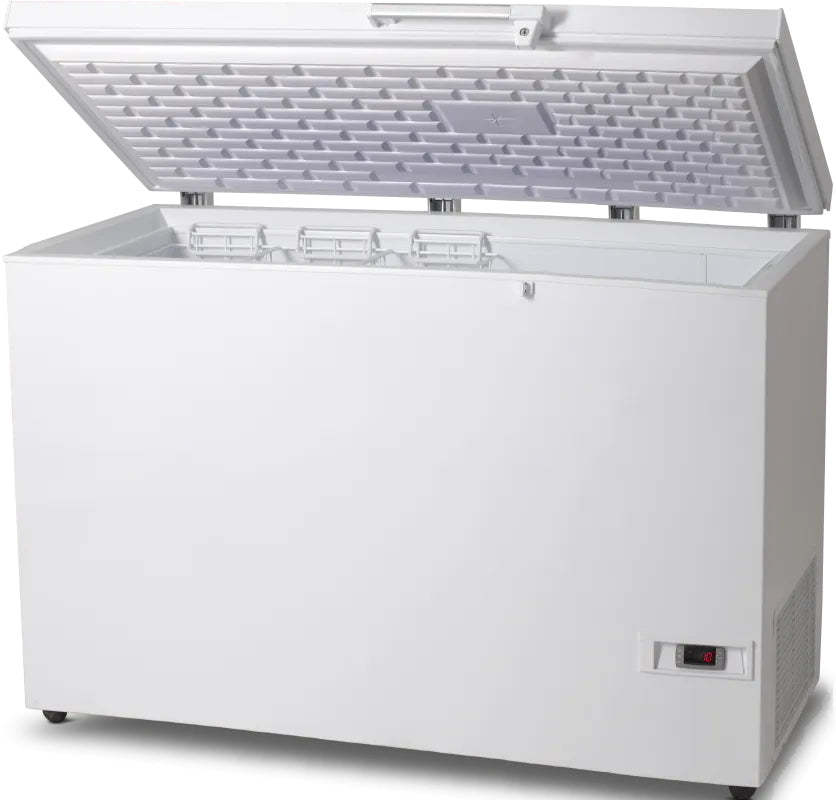
The Vestfrost VT547-60 is a ultra-low temperature chest freezer capable of holding contents down to -60°C. Unlike standard commercial chest freezers designed for food service, this unit is purpose-built for...
Specifications
- Capacity (litres)
- 476
- External depth (mm)
- 665
- External height (mm)
- 853
- External width (mm)
- 1664
Downloads
Product Description
The Vestfrost VT547-60 is a ultra-low temperature chest freezer capable of holding contents down to -60°C. Unlike standard commercial chest freezers designed for food service, this unit is purpose-built for applications where precise, sustained deep-freeze temperatures are critical — including laboratory sample storage, medical and pharmaceutical use, plasma storage, and specialist scientific environments. The chest configuration gives it a relatively compact footprint relative to its usable internal volume, and the design is straightforward to operate day to day.
Performance centres on temperature stability rather than throughput speed. In environments where samples or materials must be held within a tight temperature band consistently over extended periods, the unit's single-compressor low-energy system and well-insulated cabinet work together to maintain set conditions reliably. The digital controller gives clear readout of the current internal temperature and allows the set point to be managed accurately. Audible and visual alarms alert users to any excursion from the target range, which is particularly important in regulated or compliance-sensitive settings.
From a practical standpoint, the unit offers several features that matter in professional environments:
- Prepared for external temperature logging — important for audit trails and compliance records
- Prepared for CO2 backup connection — provides continuity of storage in the event of a power interruption
- Lock fitted as standard — appropriate where access control is required
- Hydrocarbon (natural) refrigerant — reduces environmental impact and aligns with sustainability requirements
- Cyclopentane insulation — supports efficient thermal retention throughout the cabinet
Installation requires a standard single-phase mains supply and adequate ventilation around the unit to allow heat rejection from the condenser. Chest freezers of this type perform best in ambient-controlled rooms; very warm plant rooms or unventilated storage areas can affect efficiency and temperature recovery. The chest lid should have clear vertical clearance above it for access. Given the deep-freeze operating range, the unit will take a period of time to pull down to its minimum set temperature from ambient when first switched on — this is normal and should be factored into commissioning plans.
This freezer is well suited to hospitals, clinical laboratories, research institutions, veterinary facilities, and pharmaceutical storage environments where temperatures below the range of standard commercial freezers are required. It is not designed as a food service chest freezer, and operators looking for high-volume catering blast-freeze or bulk food storage solutions would be better served by a different class of equipment. For sites needing multiple units or specific integration with monitoring systems, capacity planning is worth considering before purchase.
If you are unsure whether this unit's temperature range, capacity, or backup provisions are right for your specific application, we are happy to talk it through before you commit to an order.
Key Features
- Operates down to -60°C with stable sustained deep-freeze performance
- Digital controller with precise temperature readout and set-point management
- Audible and visual alarms trigger on temperature excursion from target range
- Prepared for CO2 backup system connection to protect stored contents
- External temperature logging capability supports compliance and audit requirements
Operational Benefits
- Maintains critical temperature bands reliably in regulated storage environments
- Alarm system gives operators early warning before stored contents are compromised
- CO2 backup compatibility reduces risk of sample or material loss during power interruption
- Temperature logging readiness simplifies compliance documentation and audit trail management
- Hydrocarbon refrigerant reduces environmental impact without affecting deep-freeze performance
Specifications
- Capacity (litres)
- 476
- External depth (mm)
- 665
- External height (mm)
- 853
- External width (mm)
- 1664
- Internal depth (mm)
- 495
- Internal finish
- Prepainted Steel
- Internal height (mm)
- 685
- Internal width (mm)
- 1495
- Number of baskets
- 3
- Power type
- 13amp Plug
- Refrigerant
- R290
- Temperature range (deg c)
- -45 to -60
- Weight (kg)
- 108
Downloads
Frequently Asked Questions
- Not in most cases. The VT547-60 is designed for scientific, medical, and pharmaceutical storage applications where temperatures below -40°C are required. Standard commercial food storage and catering operations typically require chest freezers operating in the -18°C to -25°C range, which is a different class of equipment entirely. If you are storing food products, we would recommend discussing your requirements with us to identify the right unit.
- The unit runs on a standard single-phase mains supply and requires adequate clearance around the cabinet for condenser heat rejection — fitting it into a confined or poorly ventilated space will reduce efficiency and may affect its ability to hold minimum temperatures. Vertical clearance above the chest lid is also needed for practical access. For sites planning to connect a CO2 backup system or external temperature logger, those connections should be factored into the installation planning.
- Pulling down from ambient to -60°C takes a significant amount of time — considerably longer than a standard commercial freezer reaching -18°C. The exact duration depends on the ambient room temperature and whether the cabinet is loaded during pull-down. It is advisable to allow the unit to reach its target temperature before loading sensitive samples or materials, and to factor this into your commissioning schedule.