
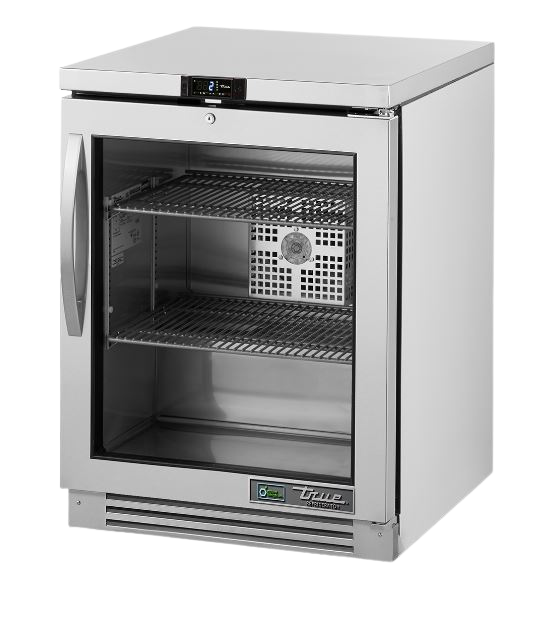
True TUC-24G-HC Glass Door Undercounter Refrigerator 158Ltr
Product Description
The True TUC-24G-HC is a single glass door undercounter refrigerator from True's established TUC range, built for commercial foodservice use from the ground up. At 158 litres, it sits in...
Specifications
- Capacity (litres)
- 94
- Climate class
- 3
- Country of origin
- US
- Energy rating
- A
Downloads
TUC-24G-HC FGD01-SpecProduct Description
The True TUC-24G-HC is a single glass door undercounter refrigerator from True's established TUC range, built for commercial foodservice use from the ground up. At 158 litres, it sits in a practical mid-capacity position — compact enough to slide beneath a standard preparation counter, yet sufficiently roomy to hold a meaningful amount of refrigerated stock at the point where it is actually needed. The glass door allows kitchen staff to identify contents without breaking the cold seal, which has a genuine impact during a busy service when repeated, unnecessary door openings are a common source of temperature instability.
True has built the TUC range around a forced-air refrigeration system rather than static cooling. In a working kitchen that distinction matters. Forced-air circulation maintains an even temperature throughout the cabinet even when the door is opened frequently during peak service. Static systems can struggle to recover quickly under those conditions, leading to temperature drift that has implications for both food safety and product quality. True's recognised commercial build standard translates to the kind of day-to-day reliability that operators need from equipment that cannot afford to fail mid-service.
From a practical standpoint, the unit offers several operational advantages worth noting:
- Glass door reduces unnecessary openings by making stock immediately visible
- Forced-air system supports consistent holding temperatures across the full cabinet
- Undercounter format keeps refrigerated stock to hand without consuming worktop space
- R290 hydrocarbon refrigerant aligns with current UK and European environmental requirements
- Commercial build quality suited to continuous daily use in demanding kitchen environments
Installation requires a standard single-phase electrical supply. As with all undercounter refrigeration, it is worth confirming adequate ventilation clearance around the cabinet before positioning it within a run of equipment. Restricted airflow is one of the more common contributors to compressor wear and inconsistent performance over time. The unit is designed for indoor, temperature-controlled environments and is not appropriate for outdoor or unheated spaces.
This unit is well suited to smaller commercial kitchens, café and bar service areas, and dedicated prep stations where reliable localised refrigeration is needed without the footprint of an upright cabinet. It also works sensibly as a secondary unit in larger operations where chilled stock needs to be staged close to a specific workstation. Sites with significantly higher throughput or storage demands may find a larger undercounter or upright model within the True range a better fit.
If you would like to talk through whether this unit suits your kitchen layout or service pattern before making a decision, we are glad to help.
Key Features
- Single glass door with full-cabinet visibility for quick stock identification
- Forced-air refrigeration system for even temperature distribution throughout cabinet
- 158-litre capacity in a compact undercounter footprint for prep-level storage
- R290 hydrocarbon refrigerant meeting current UK and European environmental standards
- Built to True's commercial specification for continuous heavy-duty daily operation
Operational Benefits
- Reduces unnecessary door openings, supporting stable temperatures during busy service
- Forced-air recovery maintains food safety compliance under repeated peak-period use
- Positions chilled stock at point of use without sacrificing worktop or floor space
- Reliable commercial build reduces risk of refrigeration failure during critical service periods
- Environmentally compliant refrigerant helps operators meet sustainability obligations
Specifications
- Capacity (litres)
- 94
- Climate class
- 3
- Country of origin
- US
- Energy rating
- A
- External depth (mm)
- 629
- External height (mm)
- 802
- External width (mm)
- 610
- Internal height (mm)
- 600
- Material
- External: Stainless steel front & countertop, aluminium sides & rear. Internal: Clear coated aluminium, stainless steel base.
- Max ambient temp deg c
- 25
- Power rating (kw)
- 0.230
- Power type
- 13amp Plug
- Refrigerant
- R290
- Temperature range (deg c)
- 0.5-3.3
- Weight (kg)
- 60
Downloads
TUC-24G-HC FGD01-SpecFrequently Asked Questions
- For a café or small restaurant using the unit as a prep-level stock point, 158 litres is generally workable provided it is replenished regularly from a larger back-of-house unit. It is well suited to holding mise en place or a rotation of frequently accessed ingredients rather than acting as primary bulk cold storage. If your service volume is high or your prep quantities are substantial, it is worth discussing whether a larger undercounter or upright cabinet would serve you better.
- The unit runs on a standard single-phase electrical supply, so dedicated specialist electrical work is not typically required. The more important practical consideration is ventilation — undercounter units need adequate airflow clearance around the cabinet, and positioning one tightly within a closed run of cabinetry without accounting for this is a common cause of reduced performance and premature compressor wear. It is also designed strictly for indoor, temperature-controlled environments.
- The glass door is primarily a visibility aid — staff can see what is inside without opening the door, which reduces the frequency of door openings and the associated temperature fluctuation. The forced-air refrigeration system supports recovery when the door is opened, but as with any refrigerated cabinet, repeated or prolonged openings in a hot kitchen environment will place greater demand on the compressor. In practice, the glass door tends to contribute to better temperature discipline rather than undermining it.