
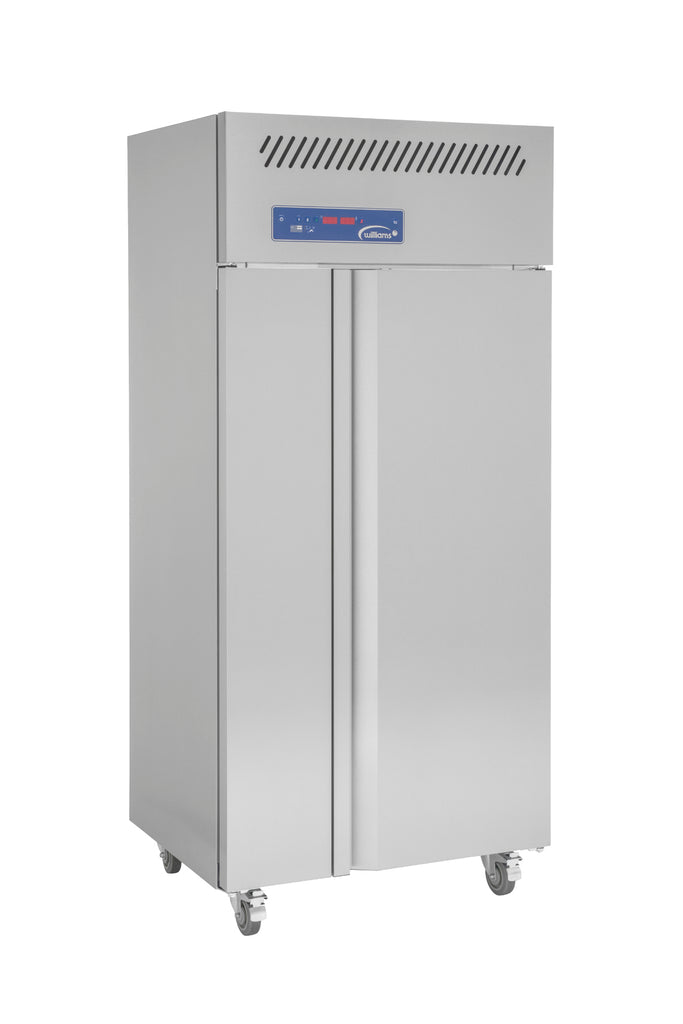
Williams Jade J1BC-SS 23kg 7 Grid Blast Chiller
Product Description
The Williams Jade J1BC-SS is a freestanding blast chiller designed to take freshly cooked food rapidly through the critical temperature danger zone and hold it safely in short-term chilled storage....
Specifications
- Capacity (grids)
- 7
- Capacity (kg)
- 23
- External depth (mm)
- 801
- External height (mm)
- 1960
- Capacity
- 23kg
- Refrigerant
- R134a
Product Description
The Williams Jade J1BC-SS is a freestanding blast chiller designed to take freshly cooked food rapidly through the critical temperature danger zone and hold it safely in short-term chilled storage. With a 23kg chilling capacity across seven grid positions, it is built for professional kitchens where cook-chill production is a regular part of service — not an occasional task.
In a working kitchen, consistent chilling across the full load matters as much as raw speed. The Jade's airflow design aims to deliver even temperature distribution across all seven positions, reducing the risk of uneven chilling where surface temperatures drop quickly but the core of denser dishes lags behind. This is particularly relevant when batch-chilling layered or high-density foods, where uneven results carry both food safety and quality implications. The unit also performs reliably in warmer ambient environments — kitchens without air conditioning or those operating through summer peaks.
From a workflow perspective, the unit supports a practical cook-chill operation:
- Hard and soft chill settings to match the cycle to food type and density
- Automatic transfer to storage mode at cycle end, reducing monitoring demands on staff
- Audible cycle-completion alerts to support throughput management
- Stainless steel construction for straightforward daily cleaning
- Self-closing doors to maintain stable internal temperatures during busy periods
Installation is relatively straightforward for a unit of this class. That said, ventilation clearance around the condenser should be confirmed at the planning stage, and the unit should be sited away from direct heat sources wherever the kitchen layout allows.
The J1BC-SS is well suited to mid-sized professional kitchens — contract caterers, hotel operations, healthcare catering, and restaurant kitchens producing in batch. Sites with significantly higher throughput per cycle may find a larger-capacity model better matched to their volumes, while smaller operations with lighter chilling demands might be better served by a reduced-capacity unit.
If you would like to talk through whether this unit is the right fit for your production volumes and kitchen setup, our team is glad to help before you make a decision.
Key Features
- 23kg chilling capacity across seven individual grid positions
- Hard and soft chill modes to suit different food types and densities
- Automatic transfer to storage mode at the end of each cycle
- Audible cycle-completion alert to support kitchen workflow management
- Stainless steel construction throughout for durability and daily hygiene
Operational Benefits
- Moves food safely through the danger zone to protect food safety compliance
- Even airflow across all seven grids reduces risk of uneven chilling results
- Automatic storage transfer reduces staff monitoring time during busy service
- Performs consistently in warm ambient kitchens without air conditioning
- Straightforward cleaning keeps hygiene standards manageable under daily use
Specifications
- Capacity (grids)
- 7
- Capacity (kg)
- 23
- External depth (mm)
- 801
- External height (mm)
- 1960
- External width (mm)
- 865
- Insulation
- 75mm
- Internal depth (mm)
- 560
- Internal finish
- Stainless Steel
- Internal height (mm)
- 1370
- Internal width (mm)
- 482
- Material
- Stainless Steel
- Max ambient temp deg c
- 43
- Power type
- 13amp Plug
- Refrigerant
- R134a
- Temperature range (deg c)
- +90 to +3
- Capacity
- 23kg
- Refrigerant
- R134a
Frequently Asked Questions
- That depends on your batch sizes and how frequently you run chill cycles during a production shift. A 23kg capacity suits mid-sized operations producing in moderate batches — contract caterers, hotel kitchens, and busy restaurant operations typically fall within this range. If your site regularly processes significantly larger quantities per cycle or runs continuous back-to-back batches at volume, it is worth discussing whether a higher-capacity unit would serve you better.
- The key practical requirement is ensuring adequate ventilation clearance around the condenser — this should be confirmed during kitchen planning rather than after delivery. The unit should be positioned away from direct heat sources such as ovens or grills where possible, as ambient heat affects refrigeration efficiency. Beyond ventilation, installation is relatively straightforward for a freestanding unit of this class.
- Soft chill is generally used for delicate foods — patisserie, cooked fish, or dishes where rapid temperature change could affect texture or structure. Hard chill is suited to denser, more robust foods such as joints of meat, stews, or high-density batch-cooked dishes where you need to drive the core temperature down quickly. Choosing the right setting for the food type is part of running a safe and effective cook-chill system.