
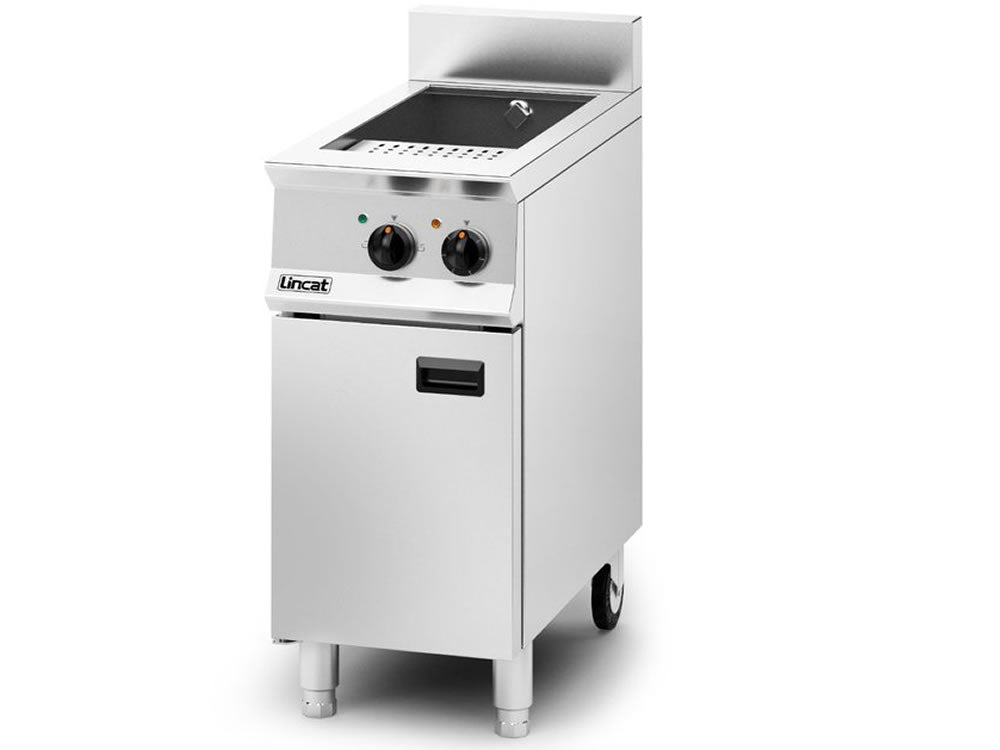
Lincat Opus OE8701 Single Tank Electric Pasta Boiler
Product Description
The Lincat Opus OE8701 is a single-tank electric pasta boiler designed for permanent installation at a dedicated pasta station. Unlike countertop pasta cookers filled manually, this unit connects directly to...
Specifications
- Capacity (litres)
- 25
- External depth (mm)
- 800
- External height (mm)
- 1020
- External width (mm)
- 400
Product Description
The Lincat Opus OE8701 is a single-tank electric pasta boiler designed for permanent installation at a dedicated pasta station. Unlike countertop pasta cookers filled manually, this unit connects directly to a mains cold water supply and a plumbed waste outlet, making it a fixed piece of equipment intended to run throughout a full service without manual intervention. Beyond pasta, it can also operate as a steamer or bain marie, which gives operators some practical flexibility when the menu or service format changes.
Consistent water temperature is the critical factor in keeping a pasta station productive during a busy service. The OE8701 uses a two-position fill setting — a fast fill mode for initial heat-up and a trickle fill mode for topping up during service. This approach limits the temperature drop that comes with adding large volumes of cold water, helping to maintain recovery times and throughput across a full sitting. Boil-dry protection provides a useful safeguard during periods when the unit is running without close attention.
Several design details contribute to practical daily use:
- Flush-fitting plate elements reduce food trap points and simplify end-of-service cleaning
- Corrosion-resistant elements are better suited to continuous water contact across multiple services
- An internal drainage tap makes end-of-day draining straightforward without lifting or tipping the unit
- The plumbed waste connection removes the need to empty the tank manually between services
Because this unit requires a plumbed cold water supply, a waste connection, and a suitable electrical supply, it is not a plug-and-go appliance. Installation planning is important, particularly where under-counter services access is limited. It is worth involving your installer at an early stage to confirm that water, waste, and electrical connections can be brought to the intended location without significant remedial work.
The OE8701 is well suited to restaurants, hotel kitchens, and contract catering operations where pasta features regularly on the menu and the volume of covers justifies a dedicated boiler at a fixed station. Kitchens with lighter or more occasional pasta output may find a smaller countertop unit more appropriate. Where an operation is running several pasta dishes simultaneously at high volume, a twin-tank configuration may be worth considering to avoid bottlenecks during peak service.
If you are unsure whether a single-tank unit will match your service volumes, or you want to talk through installation requirements before committing, the team is happy to work through the details with you.
Key Features
- Dual-position fill control for fast initial heat-up and trickle top-up
- Plumbed cold water inlet and waste outlet for permanent station installation
- Flush-fitting plate elements minimise food trap points in the tank
- Corrosion-resistant elements designed for continuous water immersion use
- Internal cabinet drainage tap for straightforward end-of-day servicing
Operational Benefits
- Maintains stable boiling temperature throughout a full busy service
- Reduces manual intervention with plumbed fill and waste connections
- Boil-dry protection safeguards the unit during unsupervised operation
- Easier end-of-service cleaning thanks to flush tank element design
- Flexible enough to serve as a steamer or bain marie when required
Specifications
- Capacity (litres)
- 25
- External depth (mm)
- 800
- External height (mm)
- 1020
- External width (mm)
- 400
- Power rating (kw)
- 6
- Power type
- Electric 1 Phase
- Weight (kg)
- 64
Frequently Asked Questions
- The OE8701 requires a plumbed cold water supply, a waste outlet connection, and an appropriate electrical supply before it can be commissioned. It is not a standalone plug-in appliance, so it is worth confirming with your installer early that all three services can be brought to the intended location, particularly if the pasta station is away from existing service runs.
- For most restaurants and hotel kitchens where pasta features on the menu but is not the sole focus of the operation, a single-tank boiler is generally adequate. Where a kitchen is running multiple pasta dishes simultaneously at sustained high volume — large contract catering sites, for example — a twin-tank configuration may be worth considering to avoid recovery delays between batches.
- The fast fill mode is used during initial heat-up to bring the tank to temperature quickly, while the trickle fill mode tops up water gradually throughout service rather than in large cold-water additions. This helps limit the temperature drop between batches, which is important for maintaining consistent cooking times and throughput when the station is under continuous demand.